


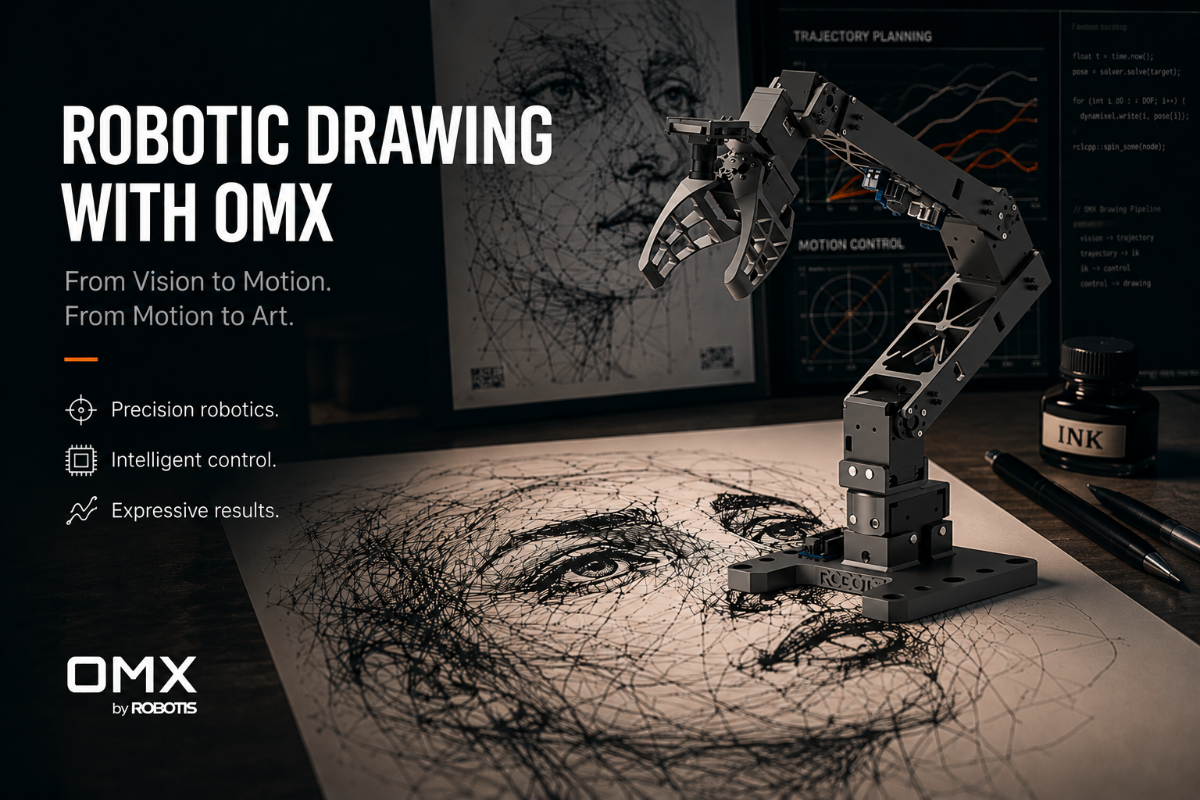
Robots In Art: Exploring OMX Trajectory Control
Posted by Mason Knittle on 12th May 2026
Exploring Robotic Drawing with OMX
An exploration of embodied computation, robotic aesthetics, trajectory generation, and expressive machine motion through OMX and DYNAMIXEL.
Drawing as an Act of Embodied Intelligence
Robotic drawing transforms computation into physical evidence. Every line produced by OMX reveals the underlying quality of the robotic system itself — from actuator responsiveness and kinematic stability to trajectory planning and vibration suppression.
Drawing occupies a unique position within robotics research because it externalizes the invisible processes of computation into material form. Unlike many robotic tasks, the resulting output is immediately legible to human observers. A single line can expose instability, latency, overshoot, or poor force regulation with remarkable clarity.
Unlike discrete pick-and-place operations, robotic drawing requires continuous contact with a deformable surface while simultaneously maintaining positional accuracy and force consistency. The task therefore functions as a uniquely sensitive benchmark for embodied robotic intelligence.
The OMX drawing framework demonstrates this convergence particularly well. Rather than merely tracing visual geometry, the system transforms visual information into dynamically executable motion primitives. Every trajectory must then be physically negotiated through the mechanical structure of the manipulator itself.
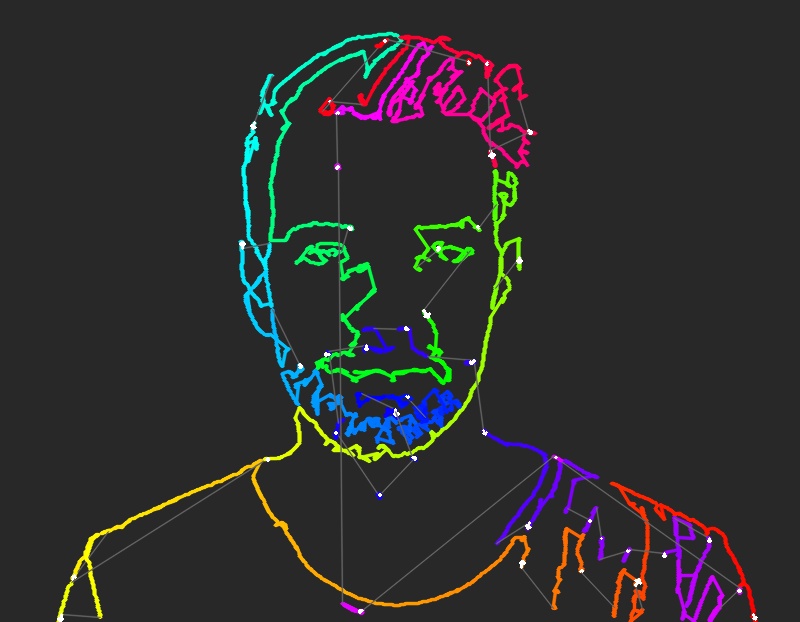
The Translation from Vision to Motion
OMX integrates computer vision, inverse kinematics, ROS 2 control architectures, and DYNAMIXEL actuation into a unified robotic drawing framework capable of transforming symbolic information into physical inscription.
|
STEP 01
Vision Processing
Visual structures are extracted and transformed into drawable geometric information.
|
STEP 02
Trajectory Synthesis
Continuous motion paths are generated for robotic execution.
|
STEP 03
ROS 2 Control
Inverse kinematics and coordinated actuator control execute the trajectory.
|
STEP 04
Material Inscription
The final line becomes a physical artifact of robotic computation.
|
Importantly, OMX does not simply reproduce digital geometry. Instead, it negotiates the translation between symbolic representation and mechanical embodiment. Every trajectory must account for actuator latency, workspace limitations, link geometry, and frictional interaction between the pen tip and substrate.
This distinction reframes robotic drawing not as image reproduction, but as a form of embodied computation enacted through motion, control theory, and physical interaction.
Patrick Tresset and the Emergence of Robotic Pathos
Long before robotic drawing became a widely accessible research demonstration, artist and researcher Patrick Tresset explored how machines could produce emotional presence through motion, hesitation, and physical inscription.
Tresset’s Human Study projects occupy a unique position between robotics, performance art, and human-computer interaction. His systems produce portraits through robotic observation and drawing, yet the significance of the work extends far beyond the resulting image itself.
Observers frequently attribute concentration, uncertainty, intention, or even emotional sensitivity to the robotic systems despite their fundamentally algorithmic operation. The machine appears to “look,” “hesitate,” and “interpret,” transforming deterministic motion into something psychologically legible to human audiences.
This transition from mechanical procedure to perceived agency represents one of the most compelling dimensions of contemporary robotics. Motion itself becomes communicative. The robot does not possess emotion in the conventional sense, yet carefully structured movement creates behaviors that human observers interpret as expressive.
In this context, systems such as OMX become more than educational robotic manipulators. They function as platforms for investigating the relationship between computation, embodiment, and aesthetic experience.
DYNAMIXEL and the Materiality of Motion
If robotic pathos emerges through motion, then the quality of that motion depends on the actuator system beneath it. In OMX, DYNAMIXEL provides the physical substrate that makes expressive robotic drawing possible.
Robotic drawing places unusually strict demands on actuator systems because the quality of the resulting mark is directly coupled to motion smoothness and dynamic responsiveness.
Within the OMX platform, DYNAMIXEL actuators provide the underlying mechanical and computational infrastructure required for stable drawing behavior. PID tuning becomes especially important during pen contact, where frictional interaction with the paper introduces micro-disturbances that must be continuously compensated for in real time.
Derivative control assists in suppressing oscillatory behavior during directional transitions, while integral compensation stabilizes contact pressure across longer trajectories. Consequently, the visual quality of the line becomes partially dependent upon actuator-level control theory.
In this sense, DYNAMIXEL functions not merely as a motor system, but as a mediating layer between symbolic intent and material execution.
Toward Machines That Leave Marks
Robotic drawing systems such as OMX reveal that robotics is no longer confined to automation alone. These systems transform visual information into motion, motion into physical inscription, and physical inscription into something humans instinctively interpret as expressive.
What emerges is not merely a drawing, but evidence of an entire computational process made visible through embodiment. Trajectory planning, inverse kinematics, actuator dynamics, control theory, and mechanical interaction become materially compressed into a single line of ink.
Projects such as Patrick Tresset’s Human Study demonstrate that this process can move beyond technical demonstration into something culturally and emotionally resonant. The machine does not simply execute commands; it performs motion in ways that observers interpret as attentive, hesitant, deliberate, or expressive.
Within OMX, DYNAMIXEL provides the physical substrate that makes this possible. Smooth trajectory execution, stable contact dynamics, and responsive control transform robotic movement from purely functional behavior into a medium capable of carrying aesthetic meaning.
OMX ultimately demonstrates that robotic drawing is not merely about reproducing images. It is about translating computation into embodied action — and allowing machines to leave visible traces of intelligence, motion, and intention within the physical world.