QC TYPE / 050 CLASSPREVIEW

QC050
QC050-110-R025-RE
8.0 N·m max.
Explore specifications
- Dimensions · D × H
- Ø46 × 52 mm
- Weight
- 250 g
- Continuous torque
- 2.5 N·m
- Maximum torque
- 8.0 N·m
- No-load speed
- 240 rpm
- Gear ratio
- 25:1
- Power
- 110 W

Meet the upcoming line of Quasi Direct Drive DYNAMIXEL actuators. Built for humanoid robotics, responsive joint control, and the next generation of Physical AI.
 QC080 / QUASI DIRECT DRIVE
A humanoid robot needs to balance, move, and respond to contact. DYNAMIXEL-Q brings a low-ratio drivetrain and embedded control into a compact smart actuator built for these demands.
Quasi direct drive connects motor output to robot motion through a modest gear reduction. The result is an architecture suited to backdrivable joints and responsive interaction.
Quasi Direct Drive architecture for dynamic robot joints.
Published input voltage across the preliminary lineup.
Two model families. Explore the announced configurations below.
Hover to reveal specs.
On mobile or keyboard, open any card.
All models shown are preliminary.
QC050-110-R025-RE

QC060-200-R020-RE
QC080-240-R020-RE

QC100-430-R020-RE
QP085-350-R020-RE
QP105-490-R020-RE
Model announced. Detailed specifications are pending confirmation: the preliminary listing repeats QP085 values and does not publish dimensions.
Preliminary values from the ROBOTIS DYNAMIXEL-Q lineup. Maximum torque is not a continuous operating rating. Model-level availability and final specifications will be confirmed at launch.
Source note: the lineup lists QC060 / QC080 weights as 455 / 865 g; the AI Sapiens hardware documentation lists 435 / 845 g. Values above follow the product lineup; confirm final mass before mechanical integration. QP105 details are held pending clarification.
DYNAMIXEL-Q / IMPEDANCE CONTROL
Impedance control sets a joint’s response through a virtual spring, damping, and optional torque assistance. DYNAMIXEL-Q combines these contributions into a motor torque command.
DYNAMIXEL-Q’s low gear reduction and low-inertia motor support backdrivability and responsive motion. Impedance control tunes that mechanical response for dynamic humanoid movement and physical interaction.
Select a control term to learn more.
Position error multiplied by kₚ produces restoring torque. Higher gain strengthens correction toward the target.
Velocity error multiplied by kᵈ contributes damping torque. With zero target velocity, it opposes joint motion.
The robot controller supplies an additional torque contribution alongside the position and velocity corrections.
In AI Sapiens, joint commands arrive over RS-485 at 6 Mbps. Each DYNAMIXEL-Q uses local position and velocity feedback to calculate torque and drive its motor.
The command has no separate inertia term; physical inertia comes from the actuator and robot.
Explore the control equation →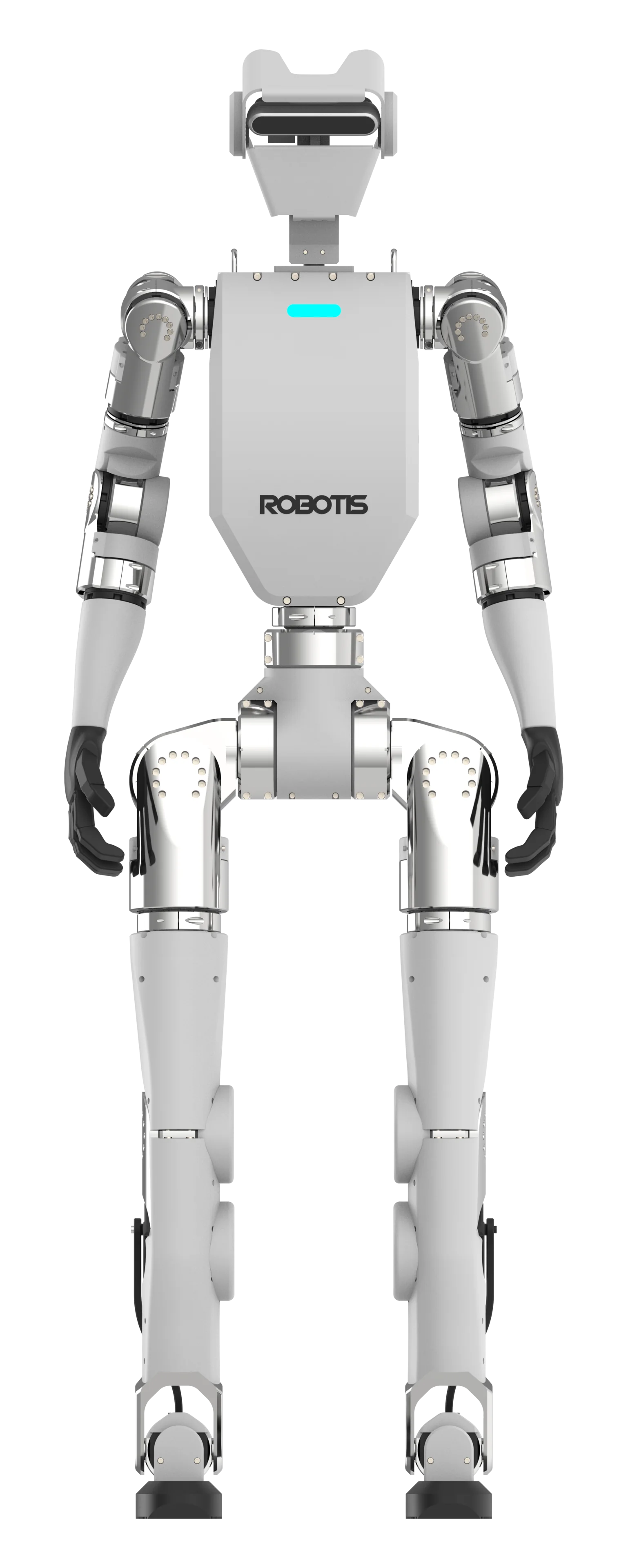
AI Sapiens K1 puts DYNAMIXEL-Q to work across a 23-DOF humanoid: 12 QC060 actuators and 11 QC080 actuators. A real platform for exploring locomotion, whole-body control, and contact-rich motion.
Explore coordinated joint motion for walking and balance research.
Connect learned behavior with physical robot interaction.
AI Sapiens workflows link simulation and policy deployment on hardware.
Investigate reinforcement learning and imitation learning on a humanoid platform.
QDD combines a motor with a relatively low gear reduction. DYNAMIXEL-Q uses this architecture to support responsive motion and interaction in robot joints.
The preliminary lineup lists QC050, QC060, QC080, QC100, QP085, and QP105 configurations. The cards above show their full model names and confirmed published dimensions where available. These are previews, not current stock listings.
The line is expected in Q1 2027. Timing, model availability, pricing, and specifications remain subject to change. Contact ROBOTIS to discuss your application.
The linked guides describe the AI Sapiens implementation. A custom robot requires its own mechanical, electrical, communication, and control integration. Share your joint requirements with ROBOTIS when planning your design.
Planning a humanoid or a new robot joint?
Start the conversation with ROBOTIS.